
Knowledge Center · DENTAL LASER
What Can Dental Lasers Help With?
Dental lasers are supportive tools in modern dentistry and may be used for gum treatment, soft-tissue care, minimally invasive periodontal support, local therapy, and recovery management.
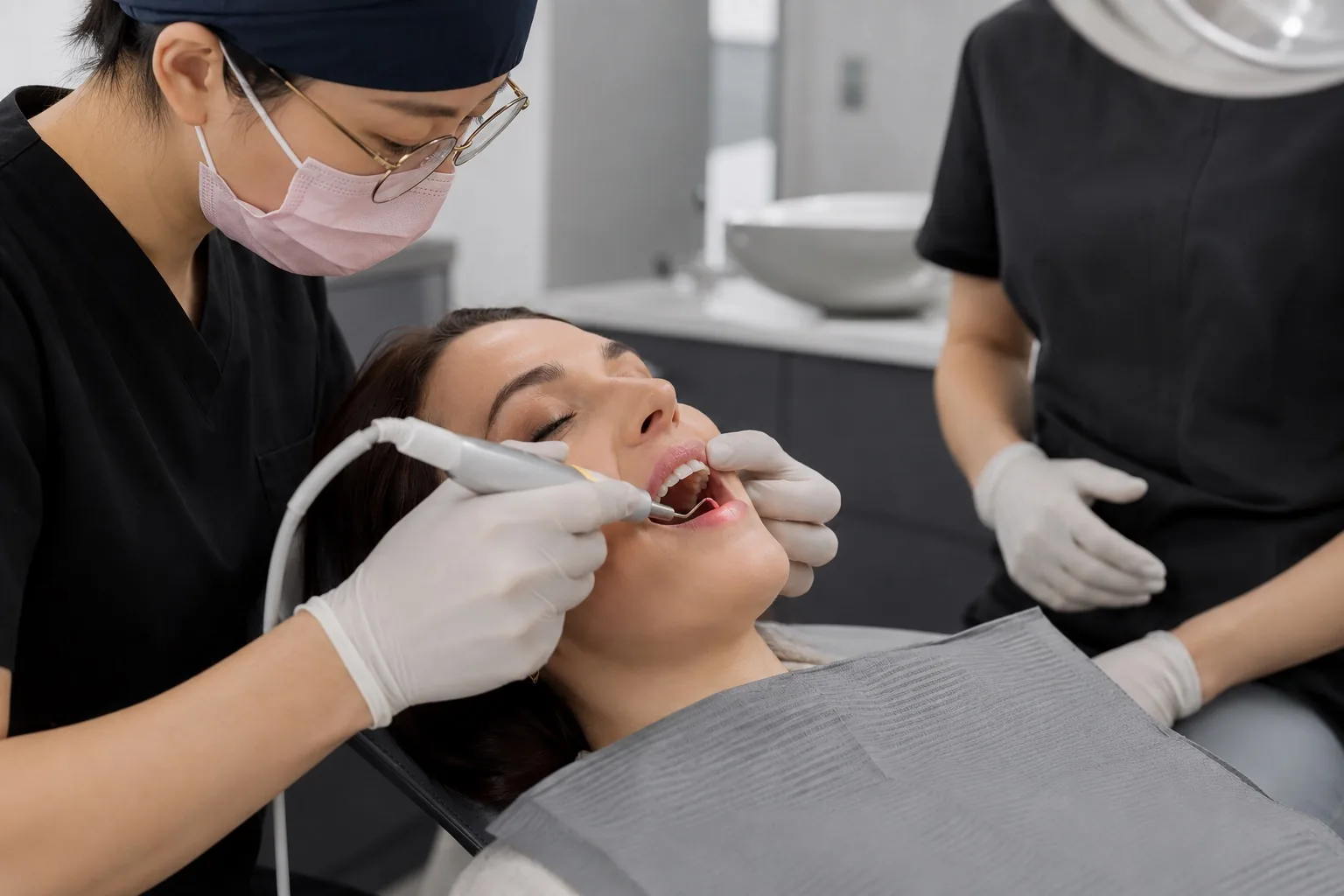
Dental lasers are commonly used as supportive clinical tools in modern dentistry.
They are not used simply to make treatment look more “high-tech.” In appropriate treatment steps, they can help dentists manage tissue more precisely, keep the procedure clearer and more minimally invasive, and make the experience gentler and easier to control.
For patients, dental lasers do not need to be understood in a complicated way. They can be thought of as a precise treatment tool: useful when a procedure requires clear boundaries, bleeding control, recovery support, or a more comfortable experience.
Where Are Dental Lasers Commonly Used?
Dental lasers are often used in gum and soft-tissue related procedures.
Common examples include gum contouring, aesthetic gingival reshaping, small soft-tissue procedures, frenectomy, and gum margin management before aesthetic restorations.
Before veneers, crowns, or implant restorations, the gum margin may influence the final restorative border, proportion, and natural appearance. If the gum contour needs careful adjustment, a laser can help the dentist work more precisely within a small area.
Dental lasers may also be used as supportive tools in selected periodontal treatments, such as local inflammation control, periodontal pocket management, and tissue recovery after treatment. They do not replace foundational periodontal care, but in suitable cases, they can make local treatment more delicate and gentler.
Some lasers are not used for cutting tissue. Instead, low-level light application can be used as supportive therapy. This may be considered for pain, inflammation, mucosal discomfort, oral ulcers, postoperative recovery, or temporomandibular joint-related discomfort.
What Can Dental Lasers Help With?
1. More Precise Soft-Tissue Management
The boundaries of gum and oral soft tissue are very delicate.
In aesthetic dentistry, gum shaping, or implant-related soft-tissue procedures, dentists need to define the treatment area clearly. A laser can help manage small areas more precisely, supporting better coordination between the gum margin, restorative border, and smile proportion.
2. Bleeding Control
Bleeding can affect visibility during soft-tissue procedures.
Some dental lasers can help with coagulation while treating tissue, making it easier for the dentist to see the working area clearly. A clearer field can make the procedure more stable and easier to control.
This can be useful in gum contouring, aesthetic preparation, periodontal care, implant-related procedures, and other soft-tissue management.
3. Minimally Invasive Periodontal Support
In selected periodontal treatments, lasers can be used as supportive tools for local inflammation control, periodontal pocket management, and tissue recovery after treatment.
The foundation of periodontal health is still plaque control, calculus removal, daily cleaning, and long-term maintenance. The role of a laser is to make selected local procedures more delicate, gentler, and easier to manage when the case is suitable.
For patients, it can be understood as a supportive step in periodontal treatment. It does not replace daily oral care or regular maintenance, but it may help dentists perform more minimally invasive and precise local management in selected areas.
4. Local Therapy and Recovery Management
Dental lasers are not only used for cutting or reshaping tissue. Low-level light application can also be used as a supportive therapy.
This type of use may be considered for pain, inflammation, mucosal discomfort, or postoperative local recovery management. For example, dentists may use laser therapy for oral ulcers, recovery after periodontal treatment, or discomfort related to temporomandibular joint dysfunction, such as pain, opening or closing discomfort, and joint catching.
The purpose of this type of laser therapy is not to remove tissue, but to help reduce local discomfort, manage inflammatory response, and support the recovery process.
Can Laser Treatment Feel More Comfortable?
In suitable situations, laser treatment may reduce certain mechanical stimulation, making the process gentler and easier for some patients to accept.
The actual experience still depends on the treatment area, tissue condition, inflammation level, individual sensitivity, and whether other procedures are performed at the same time. Whether anesthesia is needed should be decided according to the specific treatment.
A more accurate way to understand it is this: dental lasers are not a guarantee of a completely sensation-free treatment, but in selected steps, they may help dentists control the procedure better and create a gentler overall experience.
How Should Patients Understand Dental Lasers?
A dental laser can be understood as a precise supportive tool.
It is not meant to replace every traditional treatment. Instead, it can help certain steps that involve cutting, bleeding control, reshaping, or recovery management become more minimally invasive, more precise, and more efficient.
What matters most is not the device alone, but whether it is used in the right place within an appropriate treatment plan.
Summary
Dental lasers are valuable tools in modern dentistry.
They can be used in gum treatment, soft-tissue procedures, gum margin management before aesthetic restorations, minimally invasive periodontal support, local therapy, and recovery management.
Their real value is helping selected treatment steps become more precise, clearer, gentler, and more efficient within the right treatment plan.
FAQ
What dental treatments are lasers commonly used for?
Dental lasers may be used for selected gum treatment, soft-tissue reshaping, periodontal support, bleeding control, and postoperative recovery management. They do not replace every dental procedure, but in suitable cases, they can help dentists manage local tissue more precisely and keep the treatment process easier to control.
Does dental laser treatment hurt? Is anesthesia needed?
Many dental laser procedures may feel less traumatic, but whether anesthesia is needed depends on the treatment area, tissue condition, and individual sensitivity. Clinically, laser treatment should not be described simply as completely painless. The dentist should choose a comfortable and safe approach based on the specific situation.
How is dental laser treatment different from traditional treatment?
Traditional dental instruments and dental lasers each have suitable uses. The advantages of lasers are often related to soft-tissue management, bleeding control, local inflammation management, and recovery support. Some treatments still require traditional instruments. What matters most is not the device itself, but whether the dentist has judged clearly when a laser is appropriate.
Can dental lasers support periodontal treatment?
Yes. In selected periodontal treatments, dental lasers can be used as supportive tools for local inflammation control, periodontal pocket management, and postoperative recovery. However, the foundation of periodontal care is still a complete examination, plaque control, basic cleaning, and long-term maintenance. Lasers cannot replace those core steps.
What should patients pay attention to after dental laser treatment?
After dental laser treatment, patients usually need to keep the area clean, avoid irritating foods, and follow the dentist's instructions for mouth rinse use or follow-up observation. Recovery time varies depending on the procedure, so it should not be understood as being completely finished right away. The dentist will give specific care advice based on the treatment area and gum condition.