
Knowledge Center · IMPLANT DENTISTRY
Digital Implant Planning Starts With the Final Crown
Digital implant planning begins with the final crown, combining CBCT, intraoral scanning, bite, gingival contour, guided surgery, and long-term maintenance in one restorative plan.
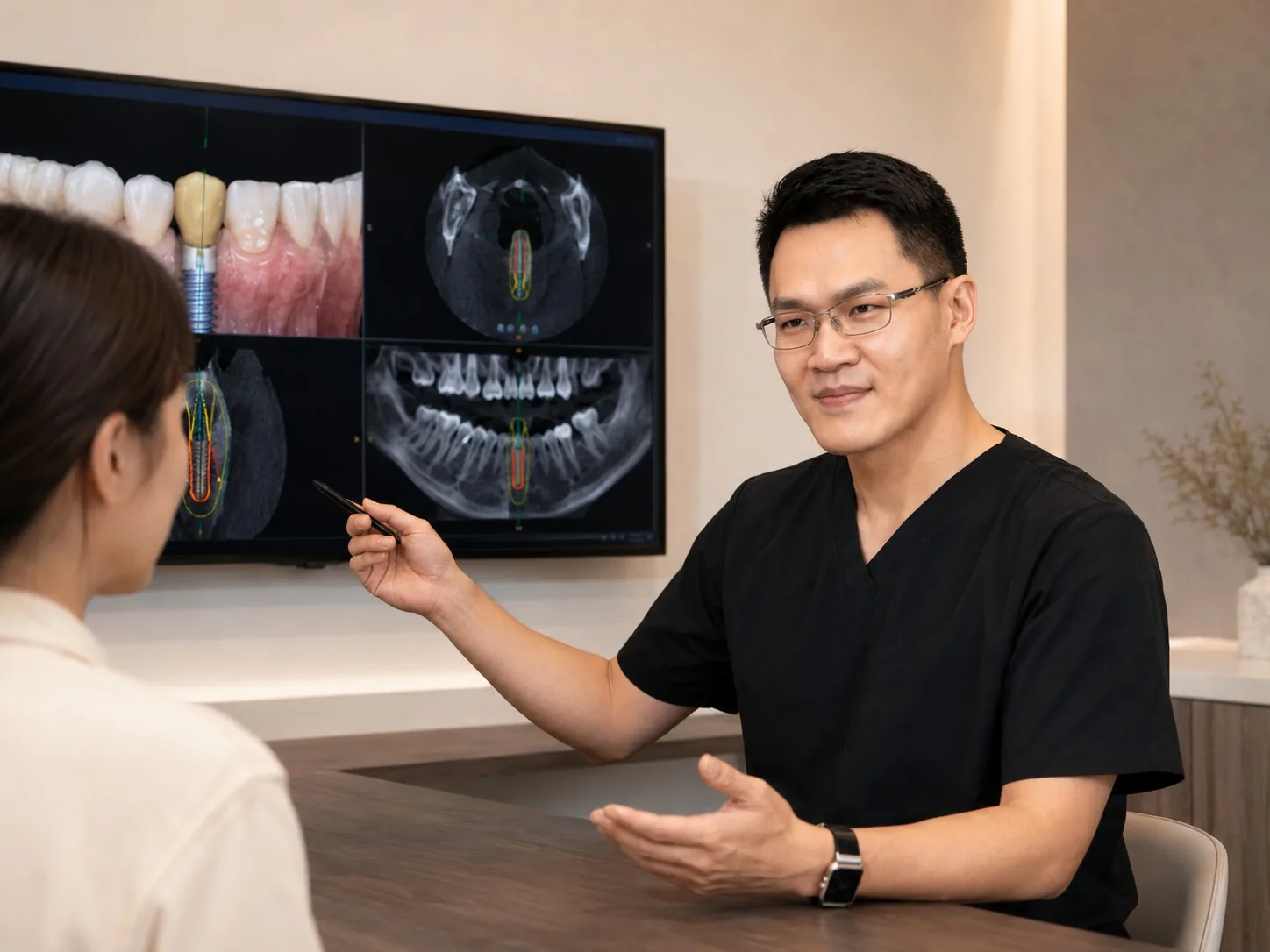
Implant treatment is not simply about placing an implant fixture into bone.
What the patient sees, uses, and cleans every day is the crown above the implant. The crown position, emergence direction, screw access, bite relationship, hygiene space, and gingival contour all affect whether the tooth will feel natural, function well, and remain easy to maintain.
That is why digital implant planning starts by asking where the final crown should be, then works backward to plan implant position, angulation, and depth.
This is a restorative-driven way of thinking: plan the tooth that will be used in the mouth first, then plan the implant fixture inside the bone.
Implant planning starts from the future crown
The final result of an implant-supported tooth depends on more than whether the implant fixture is stable. It also depends on whether the crown looks natural, whether the bite feels comfortable, whether the area can be cleaned, and whether future maintenance is manageable.
During planning, the dentist considers:
- whether the future crown position is harmonious;
- whether crown width and adjacent tooth proportions look natural;
- whether the emergence direction supports aesthetics and hygiene;
- whether the screw access position is practical for restoration and maintenance;
- whether there is enough bite space with the opposing teeth;
- whether the gingival and soft tissue contour can support the final form;
- whether follow-up, repair, and long-term maintenance will be practical.
These questions shape the actual experience of the implant-supported tooth after it enters the mouth.
Starting from the final crown helps implant treatment move closer to what the patient ultimately needs: a tooth that is natural, stable, functional, and easier to clean and maintain.
CBCT and intraoral scanning place bone and crown space in one plan
Digital implant planning usually requires different types of records to be reviewed together.
CBCT helps the dentist understand bone volume, bone width, bone height, the maxillary sinus, the nerve canal, and surrounding anatomical structures. Intraoral scanning records the edentulous space, adjacent teeth, opposing teeth, gingival shape, and bite relationship.
CBCT shows the bone. The scan shows the future crown space inside the mouth.
When these two records are combined, the dentist can evaluate the position inside the bone and the restorative result inside the mouth within the same three-dimensional plan.
That is the value of digital implant planning: it is not about looking at one image in isolation, but about discussing surgical conditions, restorative goals, and long-term maintenance within one design.
Working backward from crown position to implant direction
The position of the implant affects how the future crown emerges.
Once the future crown has been designed clearly, the dentist can work backward from crown position, emergence direction, and bite relationship to plan where the implant should be placed.
This step influences many details:
- whether implant axis supports the future crown;
- whether the emergence position looks natural;
- whether screw access is located appropriately;
- whether the crown has to become overly bulky;
- whether gingival contour in the aesthetic zone is easier to manage;
- whether hygiene space is sufficient;
- whether bite forces are directed more stably.
For the patient, the most important point is not whether the implant looks neat on an image. It is whether the tooth feels natural, functions well, is easy to clean, and supports long-term maintenance after the crown is delivered.
A digital surgical guide transfers the design into surgery more consistently
In D4’s implant workflow, we use digital surgical guides to transfer the planned implant position, angulation, and depth into surgery more consistently.
The purpose of a guide is not only “accuracy.”
More importantly, it connects the digital plan with the clinical procedure. During the design stage, the dentist has already considered the future crown position, emergence direction, screw access, aesthetic contour, bite space, and hygiene maintenance. The guide helps these design goals enter surgery more consistently.
This is especially useful in the anterior aesthetic zone, multiple missing teeth, limited bone, cases near important anatomical structures, or situations that need close coordination with the future restoration. In these cases, the relationship between preoperative design and clinical execution becomes clearer.
A digital guide does not make surgery automatic. Its value is helping the dentist bring the planned treatment goal into the clinical procedure more consistently.
Immediate, early, or delayed implant placement is also part of timing design
Many patients ask whether an implant can be placed immediately after extraction.
In digital implant planning, timing is part of the design.
Some cases are suitable for immediate implant placement, meaning the implant is placed on the same day as extraction. Some are better managed after soft tissue healing, with early implant placement. Others benefit from delayed implant placement after bone and gingival conditions become more stable.
The dentist considers infection, bony wall integrity, soft tissue condition, aesthetic-zone requirements, bite forces, and the final restorative goal when choosing the appropriate timing.
Speed is not the only goal. The more important question is which timing better supports the final crown, aesthetics, hygiene, and long-term stability.
Long-term maintenance is part of the design
After implant treatment is completed, the goal is not simply to “put the tooth in.” The goal is to help that tooth remain stable, usable, and maintainable over time.
Good implant planning considers follow-up and cleaning from the beginning:
- whether the crown shape is easy to clean;
- whether floss or interdental brushes can be used between teeth;
- whether screw access is practical for maintenance;
- whether the bite relationship is suitable for long-term use;
- whether the gingival contour supports hygiene;
- whether the structure will be clear if future repair is needed.
The implant fixture itself does not decay, but the surrounding gum and bone still need long-term maintenance. Regular follow-up helps the dentist observe gum health, bone stability, bite changes, and the restoration.
Digital implant planning therefore includes not only preoperative planning, but also long-term postoperative management.
How D4 approaches digital implant planning
At D4, implant planning is not limited to looking at one missing tooth site. We evaluate CBCT, intraoral scanning, bite, periodontal condition, future crown design, and long-term maintenance together.
We first ask:
Where should this tooth finally emerge? Will the crown look natural after it is delivered? Are the emergence position and screw access appropriate? Will the patient be able to clean it? Are bite forces stable? If future maintenance is needed, is the structure clear?
The value of digital implant planning is not to make treatment look more complex. It is to help implant treatment align more closely with the final restorative goal from the beginning.
Good implant treatment is not only about placing an implant fixture. It should start from the final crown and be designed for long-term use.
FAQ
Why does implant planning start with the final crown?
Because what the patient actually uses is the crown above the implant. The crown position, direction, emergence profile, bite relationship, and hygiene space influence whether the implant-supported tooth will look natural, function well, and be easy to maintain. Defining the final crown position first allows the dentist to plan implant position and angulation around the final restorative goal.
Why is CBCT needed before implant treatment?
CBCT helps the dentist evaluate bone volume, bone width, bone height, the nerve canal, the maxillary sinus, and nearby anatomical structures. Since the implant fixture is placed in bone, CBCT allows the surgical plan to be connected more clearly with the future restorative goal.
Why is intraoral scanning also needed for implants?
Intraoral scanning records the missing tooth space, adjacent teeth, opposing teeth, gingival shape, and bite space. Implant planning needs to understand not only the bone, but also where the future crown should be. CBCT provides bone information, while the scan provides the restorative space inside the mouth. Together, they help clarify the relationship between implant and crown.
What are the advantages of guided implant surgery?
A digital surgical guide helps transfer the planned implant position, angulation, and depth into surgery more consistently. Before surgery, the dentist evaluates the future crown position, emergence direction, screw access, aesthetic needs, bite space, and hygiene space. At D4, the guide is part of the digital implant workflow. It does not replace clinical judgment, but it makes the connection between design and surgery clearer.
Can an implant be placed immediately after tooth extraction?
Some cases are suitable for immediate implant placement, meaning the implant is placed on the same day as extraction. Other cases are better managed with early or delayed implant placement. The dentist considers infection, bony wall integrity, soft tissue condition, aesthetic demands, bite forces, and the final restorative goal. Digital planning helps the timing serve the final crown and long-term stability.
Is follow-up still needed after implant treatment?
Yes. Long-term maintenance remains important after the implant restoration is completed. Regular follow-up allows the dentist to observe gum health, bone stability, bite changes, hygiene, and the condition of the restoration. Good implant planning considers cleaning, review, and possible future maintenance from the beginning.