
Knowledge Center · PERIODONTAL MAINTENANCE
Periodontal Disease Is a Foundation Problem
Periodontal disease is not only about the gums. It affects the supporting tissues and bone that keep teeth stable.
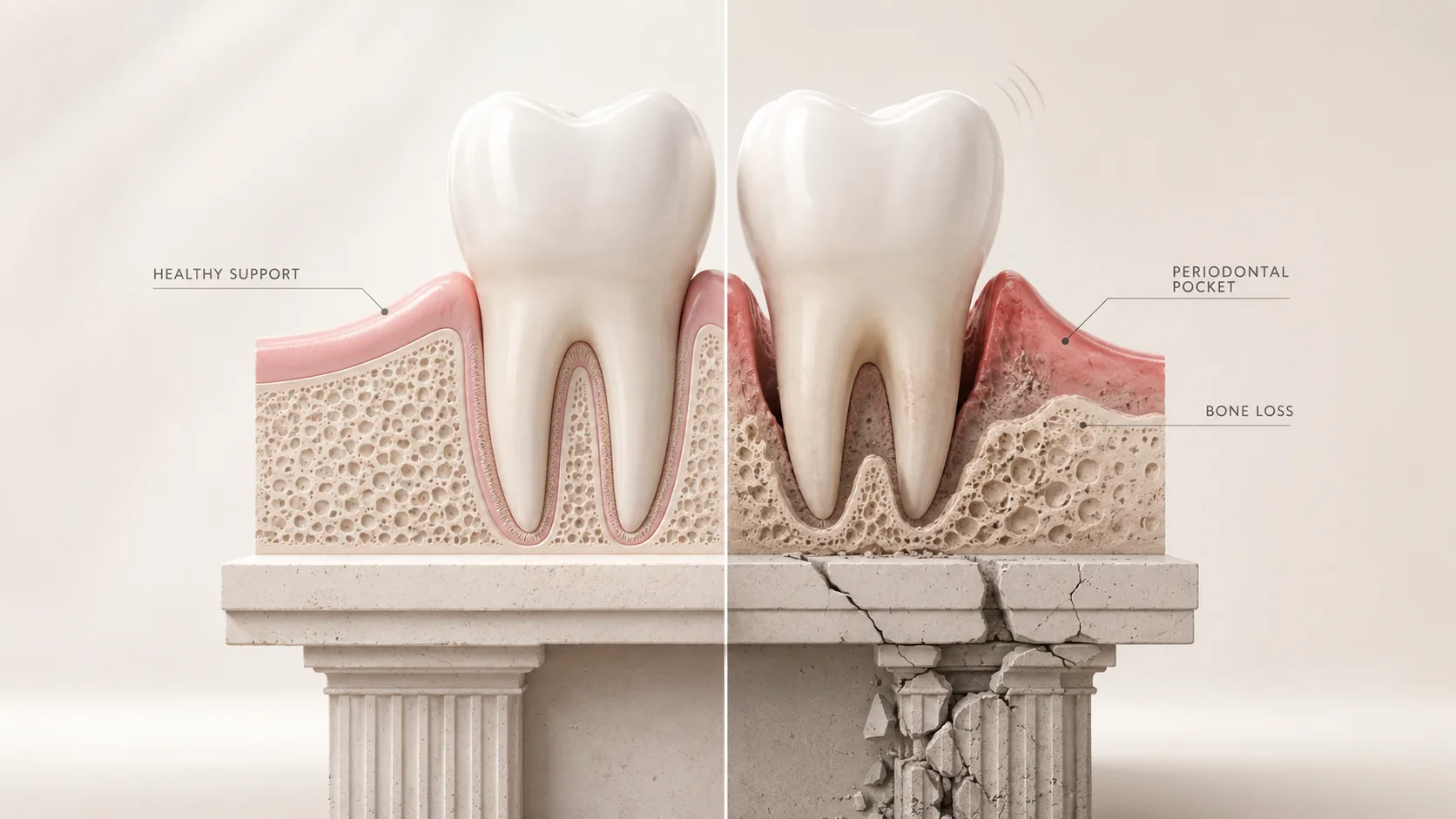
Many people think periodontal disease simply means bleeding gums.
Bleeding when brushing.
Swollen gums.
Bad breath.
Occasional soreness or slight mobility.
These are signals.
But the real problem is not only on the gum surface.
It is underneath the tooth, where the tissues that support it are gradually losing stability.
Teeth may look as if they are directly fixed in bone.
In reality, they are supported by the gums, periodontal ligament, and alveolar bone.
If a tooth is like a house, the periodontal tissues are the foundation.
Bleeding gums are like water stains on the wall.
Tooth mobility means the foundation has already been affected.
Why periodontal disease is easy to miss
The difficult part of periodontal disease is that it often does not hurt.
Cavities may hurt.
Pulpitis may hurt.
Wisdom tooth inflammation may hurt.
But periodontal disease often progresses slowly.
A little bleeding today.
A slightly larger gap tomorrow.
Teeth looking longer after a few years.
And eventually, a tooth begins to move.
By the time a patient feels that a tooth is loose, the problem is usually no longer early.
This is why periodontal disease cannot be judged by feeling alone.
Bleeding is not everything
Between healthy gum and tooth, there is a shallow groove.
When plaque and calculus stay for a long time, inflammation can deepen this groove and form a periodontal pocket.
The deeper the pocket, the harder it is to clean.
The harder it is to clean, the easier bacteria remain.
The longer inflammation persists, the more supporting bone may be lost.
So periodontal evaluation is not only about bleeding.
We also need to look at pocket depth, bone level, tooth mobility, gum recession, and whether the bite is overloading certain teeth.
The key issue is not one symptom.
It is the condition of the entire support system.
Cleaning is not the same as curing periodontal disease
Many patients ask:
“I already had a cleaning. Why do I still have periodontal disease?”
This is a common misunderstanding.
Cleaning removes plaque and calculus and helps reduce inflammation. It is an important first step.
But if periodontal pockets are already deep, or if bone loss has already occurred, one cleaning cannot automatically regenerate lost support.
Periodontal treatment is more like managing a chronic system.
First, control inflammation.
Second, stabilize the periodontal environment.
Third, maintain it long-term.
It is not a one-time project. It is long-term management.
Why periodontal health affects other treatments
Periodontal health is not an isolated issue.
It affects almost every dental treatment.
For implants, an unstable periodontal environment may increase the risk of inflammation around implants.
For orthodontics, periodontal support must be evaluated before moving teeth.
For veneers, crowns, or other restorations, chronic inflammation can affect margins, hygiene, maintenance, and aesthetics.
For smile design, gum recession, black triangles, and widening spaces can directly affect the final smile.
At D4, periodontal disease is not treated as a small side issue.
It is one of the basic conditions that must be understood before many treatments begin.
How D4 looks at periodontal problems
We do not only ask: “Is there bleeding?”
We first ask:
Is the tooth still stable?
How much supporting bone remains?
Is inflammation controlled?
Can the periodontal pocket be cleaned and maintained?
Will future restorations, orthodontics, or implants increase the load?
The important question is not only how serious it looks today.
It is whether the condition will continue to progress.
Many treatments are still possible.
But sequence matters.
Control inflammation first.
Stabilize the foundation first.
Then discuss orthodontics, restorations, implants, or aesthetic design.
This prevents later treatment from being built on an unstable foundation.
Periodontal disease is not failure
Finding periodontal disease does not mean a tooth is immediately hopeless.
Timing matters.
The earlier it is found, the easier it is to control.
The later it is treated, the fewer choices remain.
The biggest change is not one treatment.
It is a different way of understanding oral health.
Do not wait until teeth are loose.
Do not wait until gums have receded.
Do not wait until extraction becomes the only option.
How long a tooth lasts does not depend only on how beautiful the crown looks.
It depends on whether the supporting system underneath is stable enough.
Periodontal disease is a foundation problem.
The first step is not to repair the surface.
It is to ask whether the tooth can still be properly supported.
FAQ
Does bleeding gums mean periodontal disease?
Bleeding gums are commonly seen with gingivitis or periodontitis, but bleeding alone does not show how severe the problem is. Some early inflammation can bleed, while more advanced periodontal problems may not cause obvious pain. Periodontal disease needs to be evaluated by looking at pocket depth, gum recession, bone loss, tooth mobility, and imaging records, not only whether the gums bleed during brushing.
Can a dental cleaning cure periodontal disease?
Dental cleaning removes plaque and calculus from tooth surfaces and is an important step in controlling gum inflammation. But if periodontal pockets have already deepened, or if supporting bone has already been lost, one cleaning cannot automatically restore the lost periodontal support. Periodontal disease is closer to a long-term management issue. The goal is to control inflammation, stabilize the periodontal environment, and build hygiene habits that can be maintained.
Can periodontal disease make teeth loose?
Yes. Teeth are not simply fixed directly into bone. They are supported by the gums, periodontal ligament, and alveolar bone. When long-term inflammation causes bone loss, the support around the tooth becomes weaker. This can lead to tooth mobility, widening spaces, gum recession, or reduced biting strength. When a tooth is already noticeably loose, the problem is usually no longer very early.
Can periodontal disease be completely cured?
Periodontal disease should not be understood as something that is completely cured by one treatment. Early gingivitis can often improve well after timely cleaning and better oral hygiene. But if it has progressed to periodontitis, with deeper pockets, bone loss, or tooth mobility, the lost supporting tissue often cannot fully return to its original condition. Periodontitis is closer to a chronic condition that needs long-term control and maintenance. Treatment focuses on controlling inflammation, reducing further damage, stabilizing periodontal support, and lowering the risk of recurrence or progression through regular follow-up and daily cleaning. Whether a tooth can remain stable depends on the degree of periodontal damage, hygiene ability, bite force, and ongoing maintenance.
Can periodontal disease affect implants, veneers, or orthodontic treatment?
Yes. Periodontal status can affect many later treatments. Dental implants need a stable bone and soft-tissue environment. Orthodontic movement requires enough periodontal support before teeth are moved. Veneers, ceramic crowns, and aesthetic restorations also need healthy and stable gum margins. If periodontal inflammation is not controlled first, the stability, hygiene maintenance, and long-term outcome of later treatment may all be affected.