
Knowledge Center · RESTORATIVE / ORTHODONTICS
Veneers Can Refine, But Not Replace Orthodontics
Veneers can refine color, shape, and minor visual irregularities. But when the problem comes from tooth position, space, or bite, treatment sequence matters.
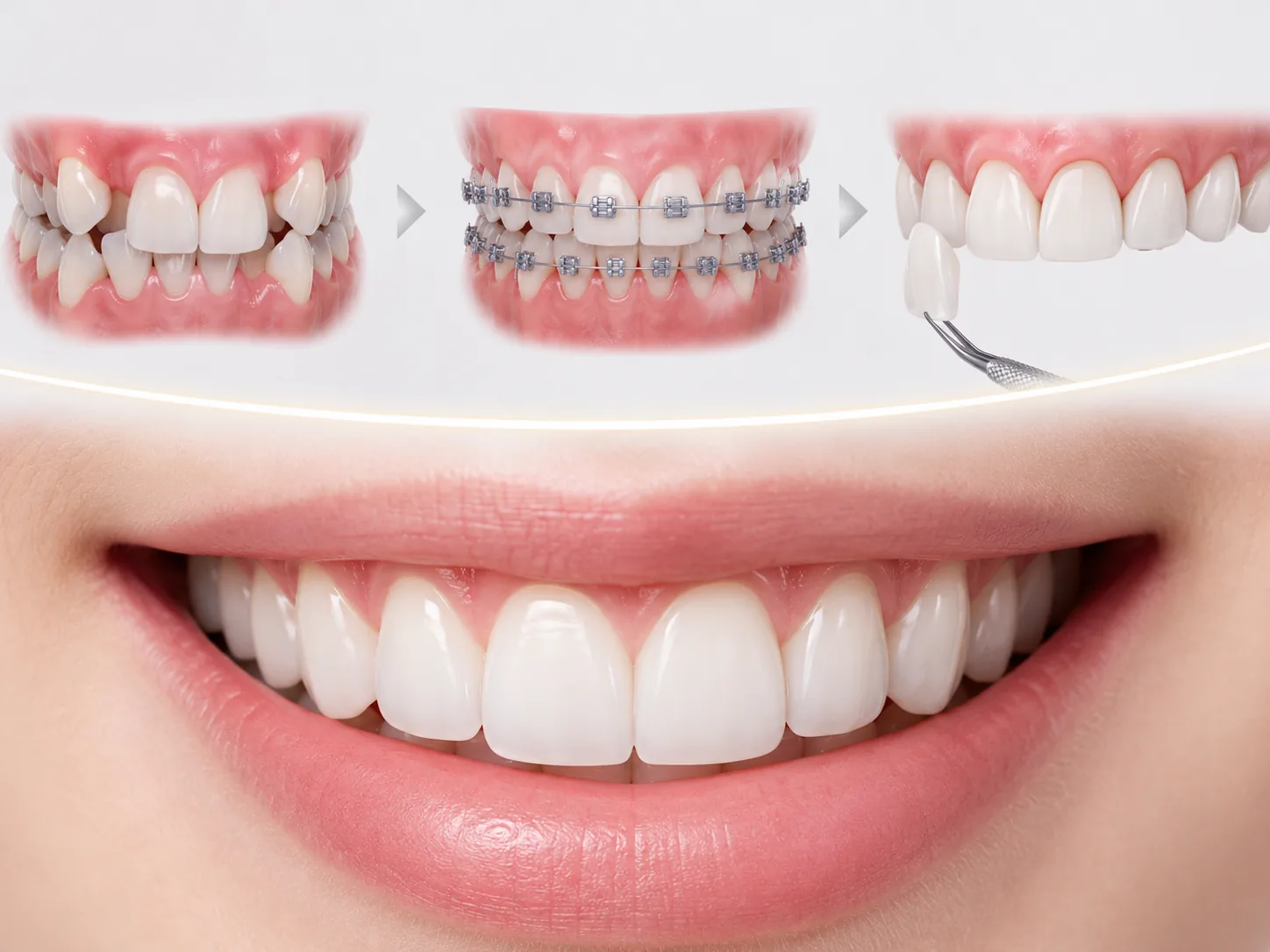
Many patients assume veneers can correct misaligned teeth.
Slight crowding.
Minor rotation.
Uneven alignment.
A smile that feels slightly irregular.
At first glance, veneers seem to solve all of these.
But clinically, this is not the full picture.
Veneers can change color, shape, proportion, and surface texture.
But they cannot move teeth.
The real question is not “veneers or not”
It is:
Are the teeth already in a position suitable for restoration?
When teeth present crowding, rotation, inclination issues, midline deviation, uneven spacing, or unstable bite, direct veneer treatment often leads to compensation.
What “compensation” means
When tooth position is not ideal:
- veneers must be thicker
- shapes are modified to visually correct alignment
- more tooth reduction may be needed
- margins become more complex
- natural appearance may be compromised
The result may look better, but structurally it is a workaround.
This is why some veneers look unnatural. The problem is not always color. Sometimes the restoration is being asked to compensate for too much position error.
Why orthodontics first
In aesthetic dentistry, orthodontics is not about perfect alignment.
It is about positioning teeth in a better restorative environment.
Such as:
- relieving crowding
- correcting rotation
- adjusting inclination
- improving anterior relationships
- creating proper restorative space
- making bite contacts safer
These changes may be small, but their impact is significant.
Position first, restoration second
Once teeth are properly positioned, veneers can focus on what they do best:
- refining color
- adjusting shape
- improving proportion
- enhancing natural appearance
- refining margins and surface texture
This allows thinner restorations, more natural results, better biological preservation, and improved long-term stability.
The advantage of “orthodontics + veneers” is not doing more.
It is allowing each step to do what it is best at.
Orthodontics manages position.
Veneers refine color, shape, and texture.
How D4 thinks
We do not start with:
“Do you need veneers?”
We start with:
Where does the problem come from?
Color?
Shape?
Position?
Gum margin?
Or multiple factors combined?
If the problem is mainly color and minor shape, veneers may be appropriate.
If the problem comes from tooth position, space, and bite, direct veneer treatment needs more caution.
Only then does treatment planning become logical.
To see how D4 brings the face, teeth, function, and patient goals into one pre-treatment discussion, continue to D4 and Digital Smile Design.
Conclusion
Veneers are not the issue.
The issue is using them in the right context.
When the problem originates from tooth position, space, and bite:
orthodontics first.
veneers second.
This is not a more complex approach, but a more conservative, natural, and stable one.
Sometimes, the most conservative aesthetic restoration does not begin with veneers.
It begins by moving the teeth into a better position for restoration.
FAQ
Do crooked teeth always need orthodontic treatment?
Not always. Crooked or uneven teeth need to be evaluated by looking at where the problem comes from. It may be a mild alignment issue, a mismatch in tooth shape and proportion, or a deeper problem related to skeletal relationship, bite, or arch space. If the issue is mainly mild shape or proportion, restorative design may sometimes improve the visual result. But if there is clear bite imbalance, crowding, protrusion, or a skeletal issue, orthodontic evaluation is usually the first step.
Can veneers replace orthodontic treatment?
Veneers cannot simply replace orthodontics. Veneers mainly change tooth color, shape, proportion, and the visual effect of minor local alignment. Orthodontics moves tooth position and improves the relationship between teeth and the bite. For small gaps, mild irregularity, or tooth shape concerns, veneers may be one option. But when tooth position is clearly the problem, relying only on veneers may require more tooth reduction and may not be the ideal approach.
Are large gaps between teeth better treated with veneers or orthodontics?
Large gaps need to be evaluated by their cause and distribution. If the teeth are naturally small or their proportions are not balanced, veneers or composite bonding may sometimes improve tooth shape and close the spaces. If the gaps come from tooth position, arch space, bite, or periodontal issues, orthodontic, periodontal, or combined treatment may need to be considered first. The key is not only closing the gap, but whether the final tooth proportions and long-term stability make sense.
Can protruding teeth be improved with veneers?
Mild anterior protrusion or tooth shape concerns may sometimes be visually improved with restorative design. But if the problem is true dental protrusion, bite protrusion, or skeletal protrusion, veneers usually cannot solve it at the root. Trying to mask obvious protrusion with veneers may make teeth look thicker or less natural, and may even affect the bite and cleaning. Suitability needs to be judged together with facial profile, tooth position, bite, and remaining tooth structure.
How should patients choose between veneers and orthodontics?
Veneers and orthodontics are not simply an either-or choice. Orthodontics is better suited for tooth position and bite relationship. Veneers are better suited for color, shape, proportion, and local aesthetic refinement. Some cases benefit from orthodontics first, moving the teeth into a better position, followed by veneers or restorations to complete the final aesthetic result. A good treatment plan is not about choosing the fastest option, but balancing tooth preservation, bite stability, visual outcome, and time cost.