
Knowledge Center · DIGITAL SMILE DESIGN
DSD Is Not Just a Smile Preview
DSD uses structured records to connect the face, teeth, gums, bite, and treatment goals so patients, clinicians, and technicians can build a shared understanding.
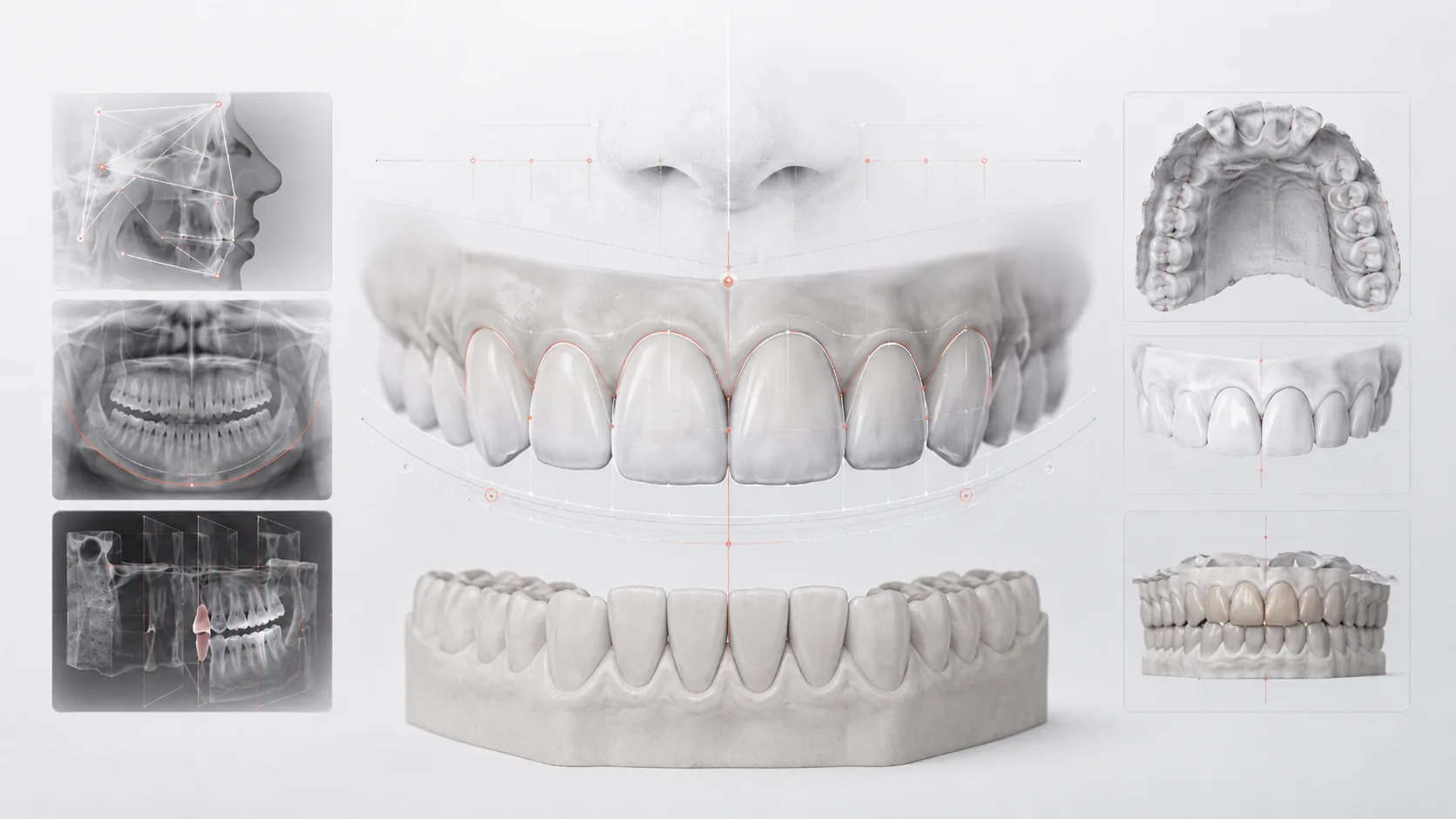
When people first hear about DSD, they often think of it as smile design software.
Take a few photos.
Create a visual preview.
Show the patient what their future smile might look like.
That is certainly the visible part of DSD.
But if DSD is understood only as a beautiful preview image, its real value is easily underestimated.
At D4, we see DSD more as a method for clinical communication and decision-making.
The first question is not “how do we make the teeth look beautiful?”
The first question is: what exactly needs to be understood?
Why does this smile feel unbalanced?
Is the issue related to tooth color, shape, position, gum line, lip line, or facial proportion?
Is what the patient wants to change the same as what clinically needs to be addressed?
If we only look inside the mouth, these questions can become too narrow.
Teeth do not exist alone.
The length of one tooth can affect the smile line.
Tooth color can influence the overall expression of the face.
The midline, tooth axis, lip line, and gingival display can all change how a person feels when they smile.
That is why the first step of DSD is not design.
It is organizing records.
Facial photos, smile photos, intraoral photos, X-rays, CBCT scans, digital scans, occlusion, gum condition, and the margins of old restorations are placed within the same system. Only then can the clinician understand the same problem from different angles.
This is where DSD differs from a simple visual preview.
A visual preview often answers one question:
“Does this look good?”
DSD needs to answer more questions:
“Why is this design suitable for this person?”
“Can this goal be achieved clinically?”
“What is the cost of achieving it?”
“What can be changed, and what should not be changed too quickly?”
“Does the patient really want something whiter and larger, or something more natural and balanced?”
These are where treatment planning truly begins.
Many aesthetic treatments do not fail because the final teeth are not white enough or because the shape is not standard enough.
They fail because before treatment starts, the patient, clinician, and technician do not share the same understanding of the goal.
The patient may think they simply want a better smile.
The clinician sees occlusion, periodontal condition, and tooth structure.
The technician needs to understand final shape, space, material, and boundaries.
If these three perspectives are not discussed through the same records, each step can become a guess.
The value of DSD is that it makes abstract ideas discussable.
It helps the patient see the relationship between the face, smile, and teeth.
It helps the clinician explain diagnosis, risk, and limitations more clearly.
It also helps the technician understand why the design exists before making the restoration.
This is not about making treatment more complicated.
It is about reducing uncertainty later.
For example, a patient may say, “I just want my teeth to look straighter.”
That sounds simple.
But clinically, it can mean many different things.
Is it minor crowding?
Is it a proportion issue?
Is the gum line asymmetric?
Is the midline off?
Or is the real issue what shows when the patient smiles?
Different causes lead to different treatment paths.
Without understanding the problem first, treatment can easily jump directly to a procedure: veneers, orthodontics, whitening, or restorations.
But the logic of DSD does not begin with a procedure.
It begins with a goal.
First, clarify what the patient truly wants to change.
Then, clarify what the clinical conditions allow.
Only then should we discuss which method is appropriate.
This is why, in many D4 cases, we spend time on photo analysis, digital records, and mock-up communication.
A mock-up is not simply a “try-in.”
It places the design back into the patient’s real face and mouth, allowing the patient to feel the change in proportion, length, thickness, and smile expression before treatment begins.
Sometimes, after seeing the mock-up, the patient realizes they do not want such a dramatic change.
Sometimes, the clinician sees that the original design needs adjustment.
Sometimes, the technician revises margins, shape, and space based on clinical feedback.
Making these adjustments before treatment is far less costly than discovering the problem after the final restoration.
So the most important part of DSD is not the image.
It is the judgment system behind the image.
It turns “I want to look better” into a goal that can be discussed.
It turns “the clinician thinks this is possible” into a plan supported by records.
It turns “beautiful technical work” into a design that belongs to the face, the mouth, and long-term stability.
The value of DSD is built on complete diagnosis, periodontal health, occlusion, tooth structure, and clinical feasibility.
The team uses these conditions and the patient’s expectations to clarify the achievable direction, treatment sequence, and key clinical requirements before treatment, then continues to validate the design throughout care.
This is how D4 uses DSD.
We use it to build shared understanding between the clinician, technician, and patient, translating visual design into a treatment plan that can be discussed, validated, and carried into clinical care.
So the patient knows what they are choosing.
The clinician knows what needs to be protected.
The technician knows what the final design should serve.
When these things are placed in the same system, treatment is no longer simply about “making beautiful teeth.”
It becomes a clearer, more stable process that respects individual differences.
DSD is not just a smile preview.
Its real value is helping everyone involved in treatment understand the same problem before treatment begins.
If you are considering veneers, you may also read: Do Veneers Always Require Tooth Preparation?
Explore D4’s DSD team and pre-treatment planning →
FAQ
What is DSD, or Digital Smile Design?
DSD stands for Digital Smile Design. It is a treatment planning method that brings the face, teeth, gums, bite, imaging records, and patient communication into one structured process. In complex cases, DSD helps clinicians discuss aesthetic restorations, orthodontics, periodontal treatment, implants, surgical planning, and the final restorative goal within the same plan, making the treatment direction, clinical conditions, and patient expectations clearer before treatment begins.
How is DSD Smile Design different from general aesthetic restoration?
General aesthetic restoration, especially veneer design, often focuses more on the color, length, shape, and visual alignment of the front teeth. DSD looks beyond the teeth alone. It also considers facial proportion, lip dynamics, gum margins, bite relationship, periodontal condition, missing teeth, implant restorative space, and soft- and hard-tissue conditions when judging treatment direction. This means DSD is not simply veneer layout. For simpler cases, it can help the clinician and patient communicate smile goals. For complex cases, it works more like a multidisciplinary planning framework, giving restorative, orthodontic, periodontal, implant, and technical design teams a clearer shared target.
Does doing DSD mean I must get veneers?
DSD is a pre-treatment analysis and planning method that can support veneers, whitening, ceramic crowns, orthodontics, periodontal treatment, implant restoration, full-mouth reconstruction, or multidisciplinary treatment. The analysis first identifies whether the concern comes from tooth color, shape, position, gums, bite, missing teeth, or the overall treatment sequence, then helps the team choose orthodontic, periodontal, implant, restorative, or more focused treatment options.
Who is DSD suitable for?
DSD is not only for people who want to improve their smile. It is also useful for patients who need complex treatment planning. Cases involving uneven tooth proportions, an unbalanced smile line, uneven gum margins, unnatural old restorations, alignment concerns, missing teeth requiring implant restoration, or combined orthodontic, periodontal, implant, and restorative treatment can all benefit from a more complete DSD analysis. In the DSD process, the clinician does not only look at tooth color and smile photos. Digital scans, photography, CBCT, periodontal status, bite relationship, implant space, soft- and hard-tissue conditions, and the final restorative goal may all be considered when deciding the treatment path. The purpose is not to design the same smile for everyone, but to find a direction that fits the individual patient better.
Will the final result be exactly the same as the DSD design?
A DSD design provides a clear treatment direction while integrating tooth condition, periodontal status, gum response, bone condition, bite relationship, material choice, and restorative space. In cases involving orthodontics, periodontal treatment, implants, or full-mouth reconstruction, the team continues to test and refine the design as treatment progresses, keeping diagnosis, Mockup, clinical care, and the final restoration connected while giving the clinician, technician, and patient a shared understanding of the goals, conditions, and treatment path.